Worked example
An employee leaves after 8 years 8 months with last drawn wages of ₹40,000 a month.
- Service counted: 8 years 8 months is more than six months into the ninth year, so 9 years
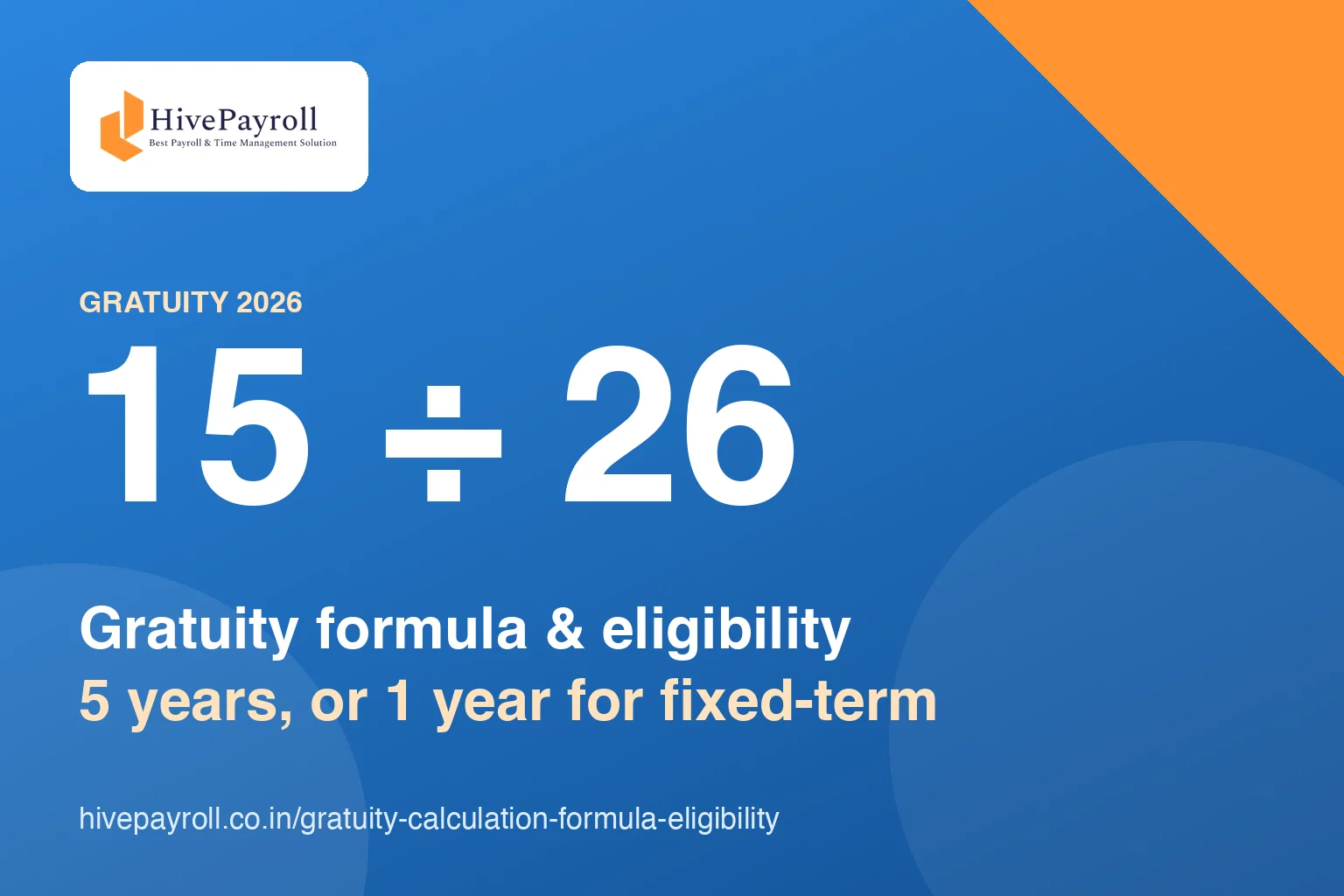
- Gratuity: ₹40,000 × 15 ÷ 26 × 9 = ₹2,07,692
An employee who leaves well short of five years of continuous service is not entitled to gratuity under the five-year rule, unless the exit is due to death, disablement or the end of a fixed term. If someone is close to the five-year line, check how continuous service is counted before you decide.
Payment, nomination and forfeiture
- Time limit: the employer must pay within 30 days of the date gratuity becomes payable (section 56(3)).
- Nomination: every employee who has completed one year of service must nominate who receives the gratuity (section 55). Collect nominations at the one-year mark.
- Death: gratuity goes to the nominee, or to the heirs if there is no nomination. A minor’s share is deposited with the competent authority.
- Forfeiture: gratuity can be forfeited to the extent of loss caused where termination is for damage to the employer’s property, and can be forfeited wholly or partly for riotous or disorderly conduct, violence, or an offence involving moral turpitude committed in the course of employment (section 53(6)).
- Better terms: an award, agreement or contract that gives more than the Code is not affected (section 53(5)).
Is there a maximum limit?
Section 53(3) says gratuity cannot exceed the amount the Central Government notifies. The limit employers have used is ₹20 lakh, from the earlier notification under the 1972 Act. We could not find a new notification under the Code that changes it as of 17 November 2026, so confirm the current figure before you pay a very large gratuity. Tax treatment of gratuity is a separate question; see the calculator page and ask your tax adviser.
For employers: provide for gratuity in payroll
Gratuity builds up every year, and the 50% wages rule can raise the base. Keep each employee’s joining date, service years and last drawn wages in one place so the figure is ready when someone resigns, and pay it with the full and final settlement. See our guide to full and final settlement. HivePayroll is free for up to 10 employees and keeps service records and settlements together.
Frequently asked questions
What is the gratuity formula in India?
Last drawn monthly wages × 15 ÷ 26 × completed years of service, with more than six months of a part year counted as a full year. The Code says 15 days’ wages per completed year.
How many years of service are needed for gratuity?
Five years of continuous service for most employees. The five-year rule does not apply on death or disablement, and fixed-term employees are paid after one year of service at the end of their contract.
Is gratuity paid if I resign?
Yes, if you have completed five years of continuous service. Resignation is one of the events listed in section 53.
Do fixed-term employees get gratuity?
Yes. At the end of the contract, after completing one year of service, according to the Labour Ministry’s compliance handbook. The amount is paid on a pro rata basis.
Within how many days must gratuity be paid?
Within 30 days from the date it becomes payable, under section 56(3) of the Code on Social Security, 2020.
Can gratuity be forfeited?
Yes, in limited cases: damage to the employer’s property (to the extent of the loss), violence or riotous conduct, or an offence involving moral turpitude committed in the course of employment.
Sources
Checked on 17 November 2026. The Social Security (Central) Rules and state rules may add details, such as the application form and the divisor. This is general information, not legal advice.