

Leave management · HivePayroll
Leave rules for the policy you actually run, with every balance traceable to the day.
Accrual from the joining date, entitlements by grade, capped carry-forward, half-day rounding and year-end with a preview. HivePayroll’s leave engine is built to remove the parallel spreadsheet.
Most leave software breaks on the policy you actually have
Leave modules are easy to build for a company that gives everyone eighteen days on 1 January. They fall apart on the policies Indian companies actually run:
What you can configure
A leave rule in HivePayroll is not a number of days. It is a policy, and each part of it is set independently:
| Setting | Options |
|---|---|
| Accrual schedule | Upfront, monthly, quarterly, half-yearly or annual |
| Accrual timing | Beginning or end of the period |
| Accrual anchor | The calendar year, or each employee’s date of joining |
| Credit method | A flat number, a tiered figure, or a formula based on days present |
| Tiered by | Tenure, designation or grade |
| Proration | None, by calendar days, or by working days; on joining and on exit, set separately |
| Rounding | None, half up, to the next or previous half day, or to the next or previous whole day |
| Year end | Reset to zero, carry forward, or encash |
| Carry-forward cap | A fixed number of days, or a percentage of the balance |
| Going negative | Automatically convert to loss of pay, or allow a negative balance |
| Who it applies to | Everyone, or filtered by gender and marital status |
| Encashment rate | A fixed amount per day, or derived from a salary component |
Eligibility by gender and marital status
How maternity, paternity and marriage leave get configured without maintaining separate employee lists.
Credit tiered by tenure
How “twelve days for the first two years, eighteen after that” becomes a rule instead of an annual manual adjustment.
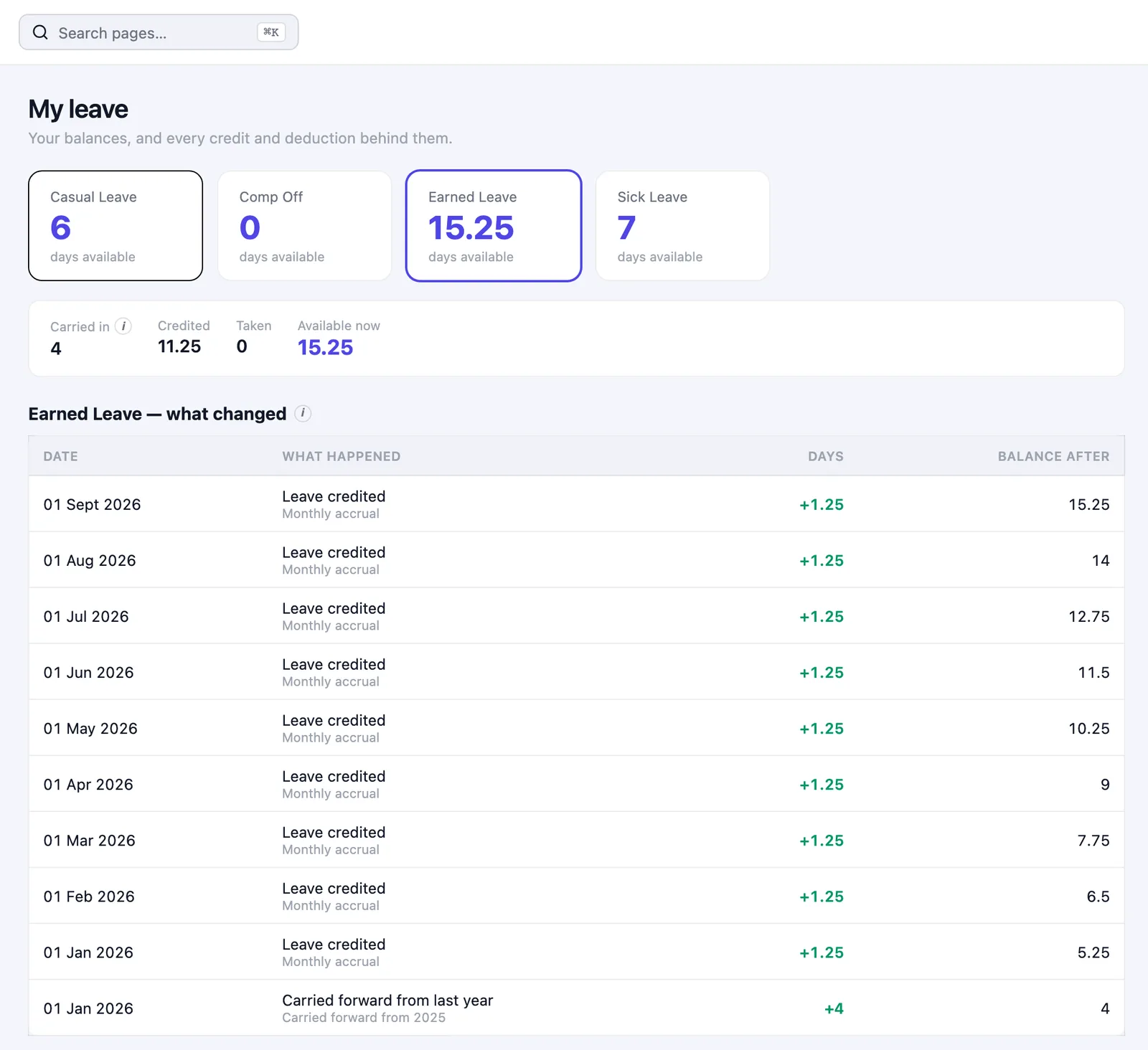
Every balance can be explained
The most common leave dispute is not about policy. It is an employee who thinks the balance is wrong and an HR team that cannot prove otherwise.
Year-end processing, with a preview
- Carry forward, lapse and encashment run together as one year-end process.
- It previews before it commits. You see what each employee’s balance will become, and what the encashment will cost, while it is still reversible.
- Commit when it is right. A year-end run that has been previewed and not yet committed changes nothing.
Comp-off, optional holidays and site calendars
Comp-off, including the part everyone forgets
Comp-off policies cover the earning side and the expiry side. Unused compensatory off that never expires quietly becomes an unfunded liability; HivePayroll lets you set when it lapses, and shows you what is about to.
Optional holidays employees choose themselves
Where you run a floating or optional holiday list, employees pick the ones they want from the calendar and those picks go through approval like any other request, rather than arriving as an email to HR in December.
Holiday calendars by site
Holiday calendars can differ by site, so a Bengaluru office and a Pune plant do not have to share one list.
Applying, approving and getting on with it
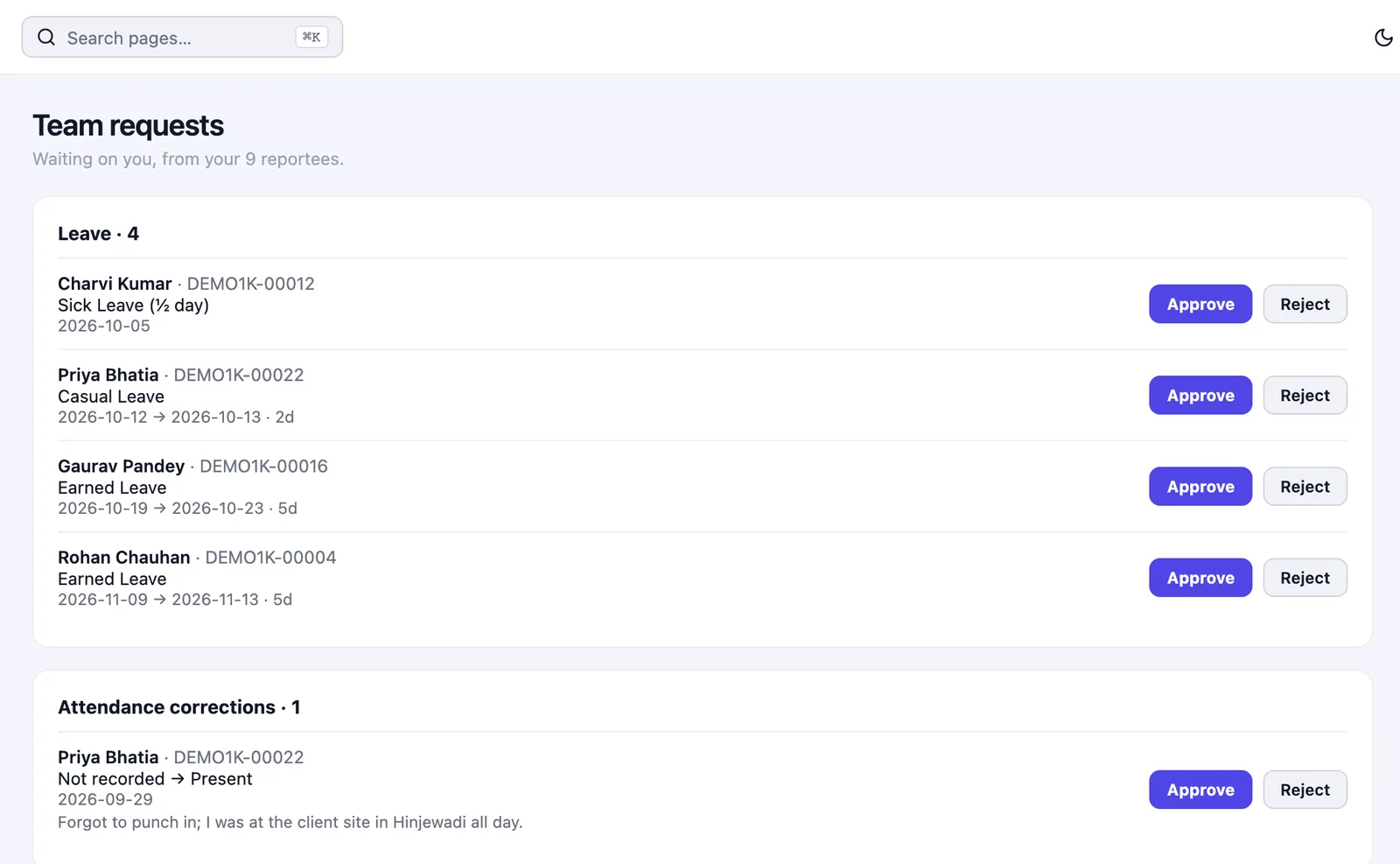
Employees apply
From their own space, and can see exactly where the request has reached.
Managers approve
Their team’s requests directly, instead of routing through HR.
Workflows route
Where a request needs more than one approval, an approval workflow decides who it goes to.
Moving from your current system
Leave is the hardest thing to migrate, because you are not moving a number; you are moving a number that has to stay defensible. HivePayroll’s migration process:
- Analyses your existing rules
- Flags the ones that will not translate cleanly
- Previews the resulting balance for every employee
- Only then commits
Frequently asked questions
Can leave accrue from the joining date rather than the calendar year?
Yes. Accrual can be anchored to the calendar year or to each employee’s date of joining, and prorated on joining and on exit independently, by calendar days or working days.
Can different grades get different entitlements?
Yes. Credit can be tiered by tenure, designation or grade, so one rule covers a policy that varies across the organisation instead of needing a rule per group.
What happens to unused leave at year end?
Whatever you configure: reset to zero, carry forward, or encash. Carry-forward can be capped at a fixed number of days or a percentage. All three run in one year-end process with a preview before it commits.
Can an employee go into a negative balance?
Your choice per rule. Either the excess automatically becomes loss of pay in the payroll run, or the balance is allowed to go negative and recovers as leave accrues.
How is maternity or marriage leave restricted to the right employees?
Rules can be filtered by gender and marital status, so eligibility follows the employee record instead of a manually maintained list.
Can employees see how their balance was calculated?
Yes. The leave passbook shows every day added, taken, lapsed, carried forward or encashed, with the reason for each.
Bring your hardest rule to the demoThe fastest way to test leave software is to make it configure the policy you currently maintain by hand. Book a free demo and bring that rule, not the simple one. Or see HivePayroll pricing; HivePayroll is free for up to 10 employees.