

Statutory compliance · HivePayroll
PF, ESI, Professional Tax, LWF, TDS and NPS, calculated in the payroll run and produced as files you can file.
HivePayroll calculates each obligation inside the monthly payroll run, so the liability and the return come from the same numbers that produced the payslip. There is no second system to reconcile against.
What payroll statutory compliance actually covers in India
Statutory compliance in Indian payroll is not one obligation. It is six or seven of them, each with its own rate, its own due date, its own return format, and, for Professional Tax and Labour Welfare Fund, its own rules in every state you employ people in. Miss one and the penalty usually costs more than the contribution did.
| Obligation | What HivePayroll produces |
|---|---|
| Provident Fund (EPF) | Employee and employer contributions, plus the ECR file ready to upload to the EPFO portal |
| Employees’ State Insurance (ESI) | Employee and employer contributions, an eligibility check as salaries change, and the ESIC return |
| Professional Tax (PT) | State-wise deduction, a PT return and a PT detail return |
| Labour Welfare Fund (LWF) | State-wise deduction and the LWF return |
| TDS on salary | Monthly deduction, quarterly position, challans and the Form 138 (earlier Form 24Q) filing steps |
| National Pension System (NPS) | Contribution handling and the NPS subscriber file |
| Gratuity | Tracked as a liability head alongside PF, ESI and PT |
The law behind it
The four Labour Codes
In force from 21 November 2025: the Code on Wages, the Code on Social Security (which now carries PF, ESI and gratuity), the OSH Code and the Industrial Relations Code. They replaced the older wage, bonus and social security Acts.
Income-tax Act, 2025
In force from 1 April 2026. The salary TDS return is now Form 138 (earlier 24Q) and the annual certificate Form 130 (earlier Form 16); 2025-26 still uses the old forms.
State laws
Professional Tax and Labour Welfare Fund are set by each state. See professional tax slabs by state and labour welfare fund by state, checked against each state’s official notifications.
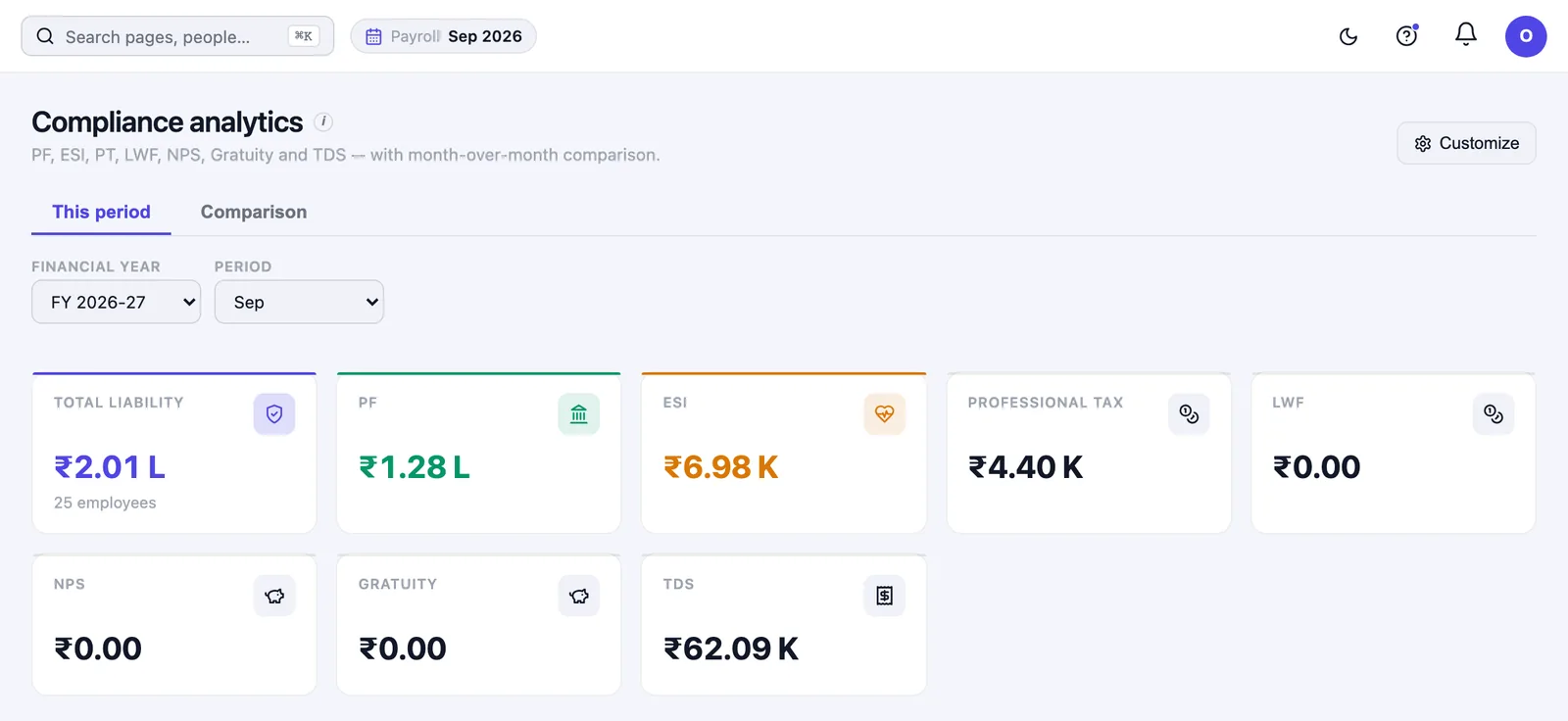
One dashboard for the whole statutory position
What it shows
Your total liability for the period broken down by head (PF employee, PF employer, ESI employee, ESI employer, Professional Tax and Gratuity) with the split between what the employee bears and what the company does, and the current period beside the last one.
What it answers
The question most finance teams actually ask at month end: what do we owe, to whom, and is it more than last month. If it is, the drill-down tells you which head moved.
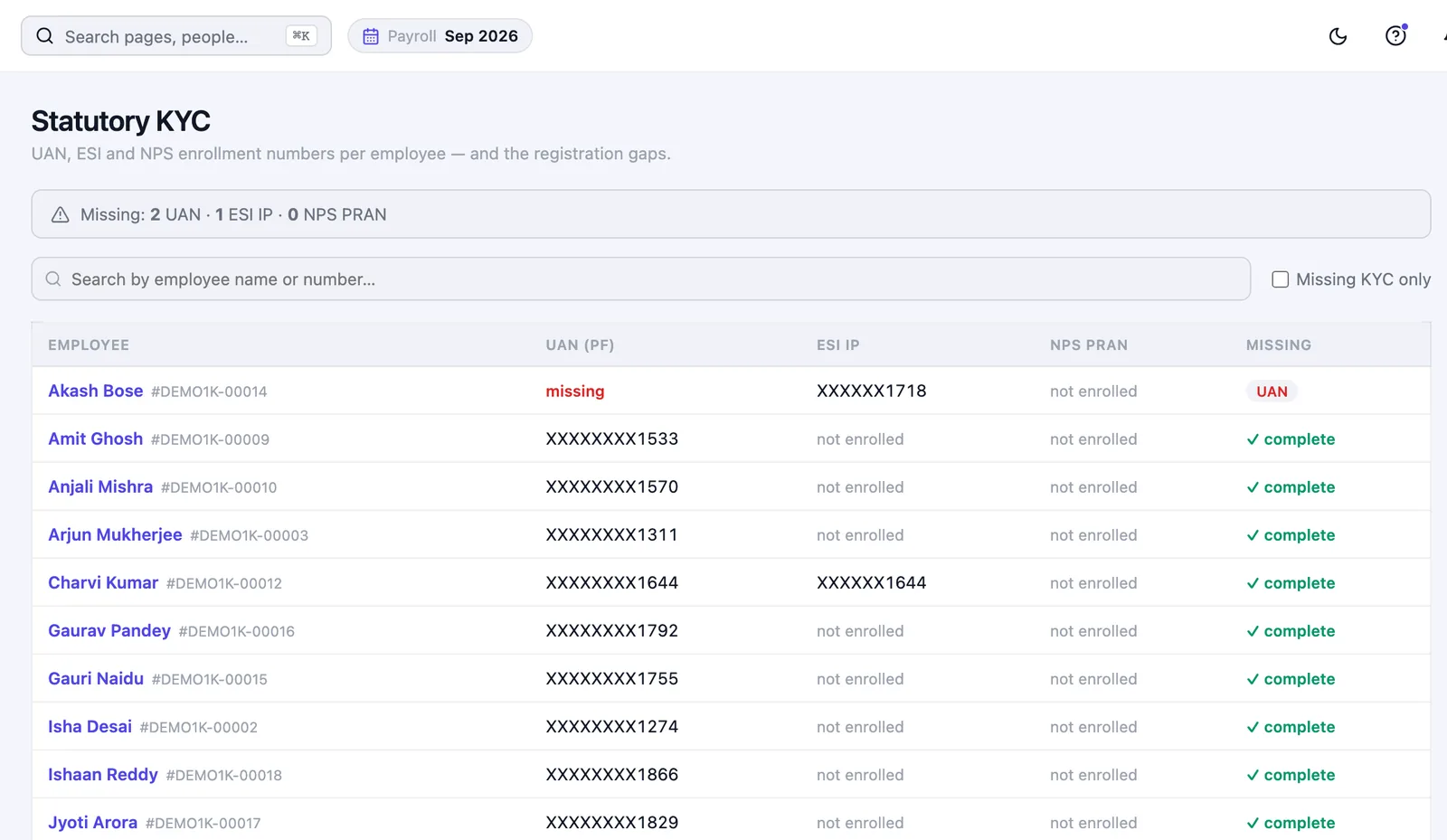
The check that saves you the most: statutory KYC
Most statutory filings fail for a boring reason. You discover it when the upload is rejected, usually on the due date.
ESI eligibility as salaries change
An employee crossing the ESI wage ceiling mid-contribution-period does not simply stop being covered. Getting this wrong in either direction is expensive:
Deduct when you should not
You owe the employee.
Fail to deduct when you should
You owe ESIC, with interest.
HivePayroll tracks eligibility as salaries change and shows you who has moved, so the decision is deliberate rather than discovered.
Returns you can actually download
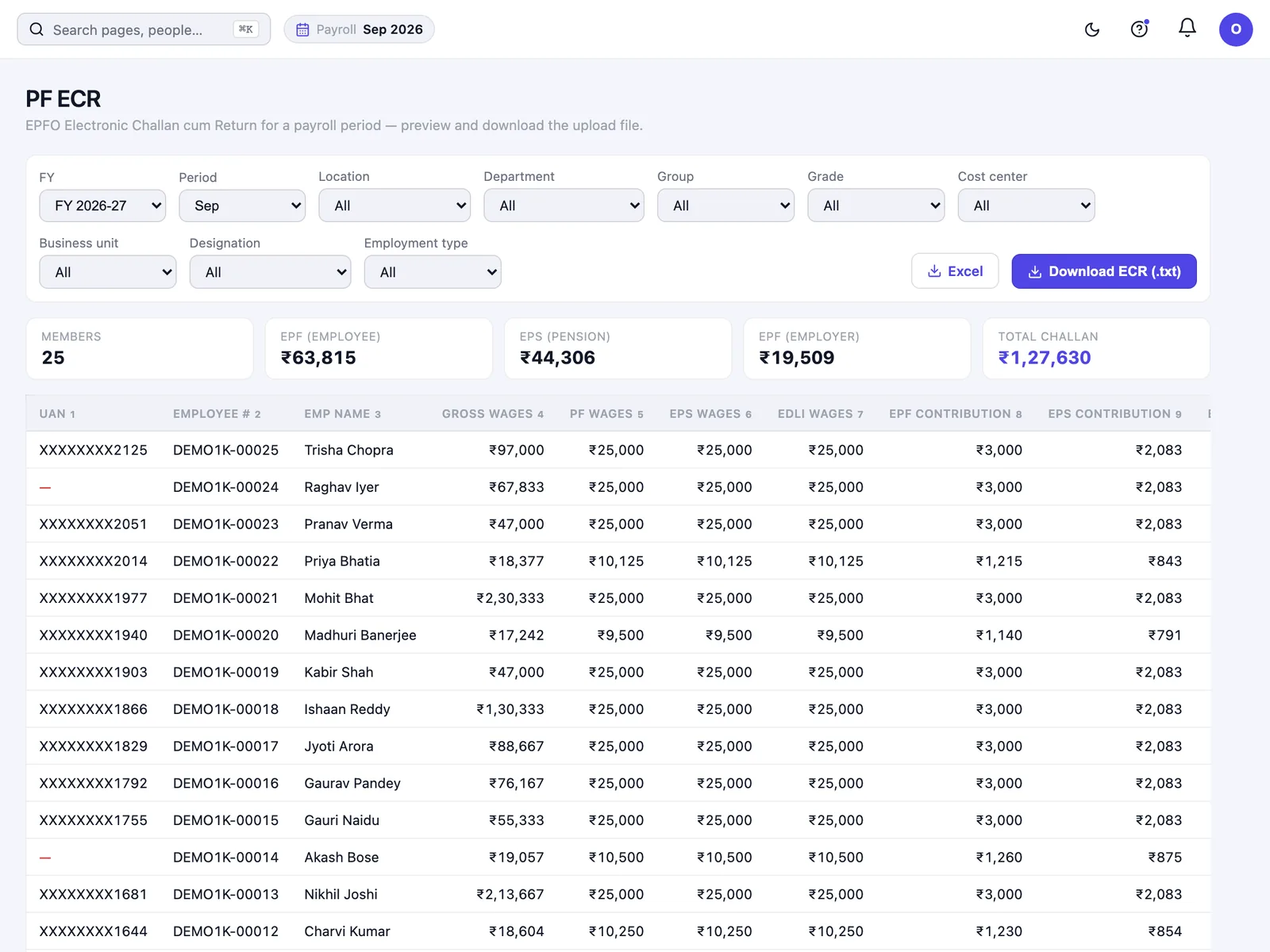
Compliance software that calculates correctly but hands you a screen to retype from is only half a system. Every statutory return in HivePayroll is produced as a file:
Formatted for upload to the EPFO portal.
The monthly contribution return.
Professional Tax return and PT detail return, per state.
Labour Welfare Fund return, per state.
For NPS contributions.
Statutory register and statutory muster, for inspections and audits.
Each one can be filtered by department, location, cost centre or business unit before you download it, which matters when a single company files separately for separate registrations.
Collecting investment declarations
Employees submit their investment declarations themselves, and payroll reviews them in one queue rather than in an inbox. The declaration form filters what it offers by the employee’s tax regime, so people are not entering deductions that will not apply to them. See TDS and income tax management for how those declarations flow into the monthly deduction and the year-end filing.
Frequently asked questions
Does HivePayroll handle Professional Tax for every state?
Professional Tax is deducted at the applicable state rate and produced as both a PT return and a PT detail return. Because PT registration is state-specific, returns can be filtered by location so a company operating in several states files each one separately.
Can I get the PF ECR file directly, or do I have to build it?
Directly. The ECR is generated from the same payroll run that produced the payslips, formatted for upload to the EPFO portal.
What happens when an employee crosses the ESI wage ceiling?
HivePayroll tracks ESI eligibility as salaries change and shows you who has moved past the ceiling, so you can apply the contribution-period rules deliberately rather than finding out at filing time.
How do I know my employee data is ready to file with?
The statutory KYC check scans for missing PAN, UAN and bank details across your employee master and lists who is incomplete, before the filing rather than after the rejection.
Is gratuity included?
Gratuity is tracked as a liability head on the compliance dashboard alongside PF, ESI and Professional Tax, so your provision is visible in the same place as the rest of your statutory position.
See it against your own rulesThe fastest way to test any payroll vendor on compliance is to make them run your hardest case before you sign: a multi-state PT setup, an employee crossing the ESI ceiling, a mid-year joiner. Book a free demo and bring it with you, or see HivePayroll pricing. HivePayroll is free for up to 10 employees.