

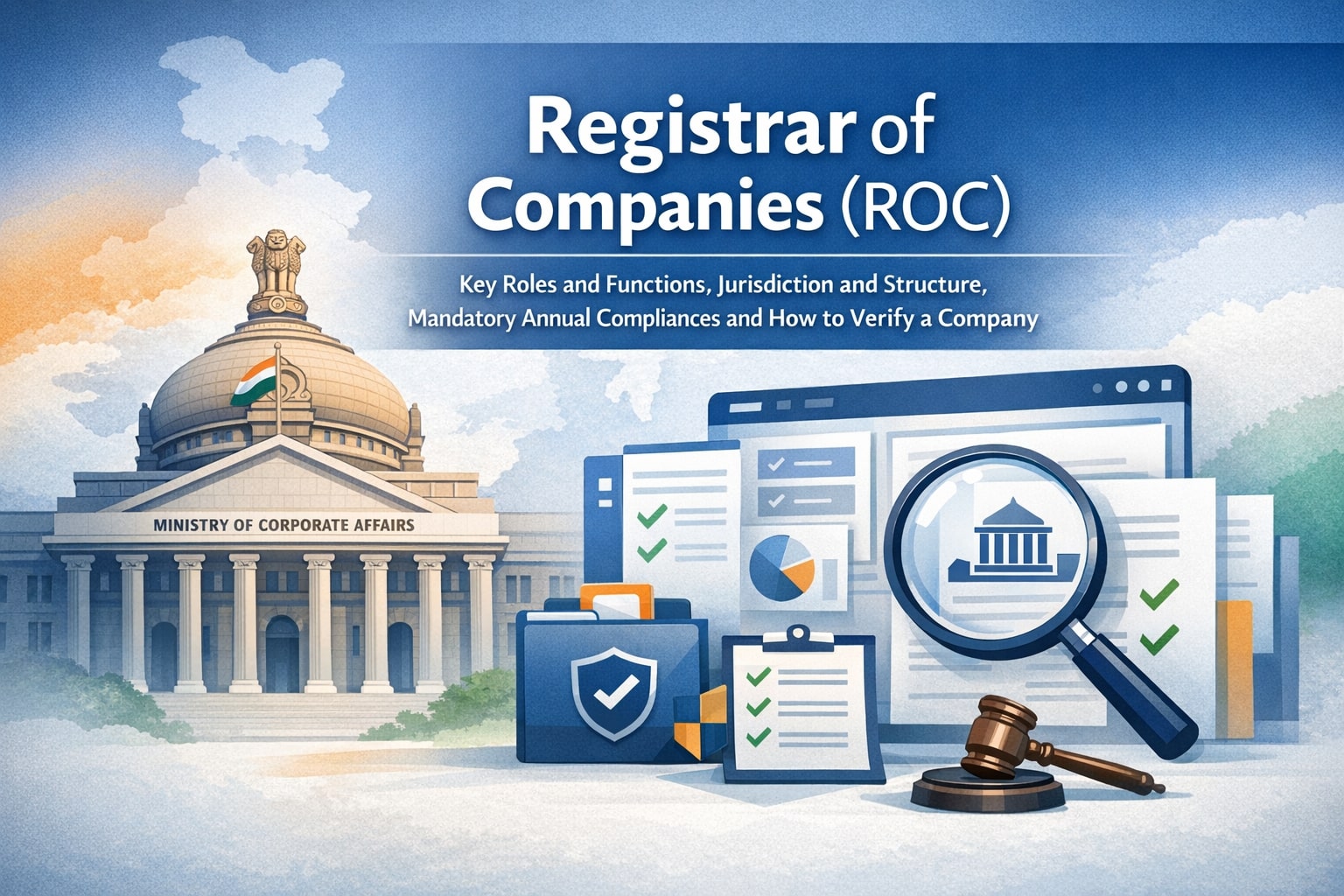
The Registrar of Companies (ROC) is a key regulatory authority under India’s corporate governance system, operating under the Ministry of Corporate Affairs (MCA). Simply put, ROC is responsible for registering companies in India and ensuring they follow the rules laid down under the Companies Act. From the moment a company is incorporated to every major compliance it files during its lifetime, ROC acts as the official record-keeper and watchdog. If you want to understand whether a company in India is legally compliant, active, or trustworthy, ROC data is where that story begins.
For immigrants and new business owners in India, understanding ROC is not optional—it is essential. Many people assume that company compliance is only a concern for accountants or lawyers, but in reality, it directly affects job security, business partnerships, investments, and even visa-related decisions. Immigrants often rely on Indian companies for employment, consulting contracts, or joint ventures. Knowing how ROC works helps you verify whether a company actually exists, whether it files its annual returns, and whether it has legal or compliance red flags that could put you at risk.
ROC knowledge becomes critical in real-life situations more often than people expect. For example, before joining a startup, checking its ROC status can reveal if it is active or already marked as “strike off.” Before entering a partnership, ROC filings can show who the real directors are and whether the company has pending charges or defaults. Even delays in ROC compliance can lead to heavy penalties and director disqualifications, which may suddenly disrupt business operations. Understanding ROC empowers you to make informed, safer decisions instead of relying on assumptions or verbal assurances.
The Registrar of Companies (ROC) is a statutory authority established under the Companies Act, 2013 (and earlier under the Companies Act, 1956). Its primary role is to administer and enforce company law in India. Every company, whether a private limited company, public company, or one-person company—comes under the jurisdiction of an ROC office based on the state in which it is registered. From incorporation documents and annual returns to changes in directors and company status, ROC legally maintains and validates all critical corporate records.
The Registrar of Companies (ROC) plays a central role in ensuring that companies in India operate within the legal framework laid down by the Companies Act. Its responsibilities go far beyond company registration. From monitoring compliance to taking action against defaulting companies, ROC acts as both a regulator and a public record authority. Understanding these functions helps you see why ROC data is so important for business owners, employees, immigrants, and investors alike.
One of the most visible roles of the ROC is overseeing company incorporation. When a company is formed in India, its incorporation documents—such as the Memorandum of Association (MOA) and Articles of Association (AOA) are filed through the MCA portal and examined by the ROC. The ROC verifies whether all legal requirements are met before issuing the Certificate of Incorporation.
This process ensures that only legally valid companies enter the Indian business ecosystem. For immigrants or first-time entrepreneurs, this oversight provides assurance that a registered company is not just a name on paper but a legally recognized entity under Indian law.
The ROC acts as the official custodian of company records. Every company is required to file various documents throughout its lifecycle, including annual returns, financial statements, details of directors, shareholding patterns, and charges on assets. All these filings are stored and maintained by the ROC in electronic form.
These statutory records are publicly accessible to a large extent, which promotes transparency. Anyone can check basic company details, making it easier to verify employers, business partners, or investment opportunities before making important decisions.
Another critical function of the ROC is monitoring ongoing compliance. Companies are required to file specific forms within prescribed timelines every year and whenever certain events occur (such as director changes or capital increases). The ROC tracks these filings and identifies defaults or delays.
If a company repeatedly fails to comply, it may face penalties or further regulatory action. For new business owners, this highlights the importance of timely compliance, while for immigrants, it serves as a warning sign when dealing with companies that consistently ignore ROC obligations.
When non-compliance is detected, the ROC has the authority to issue notices, levy penalties, and conduct inspections. Notices may seek clarification, additional documents, or explanations for delayed or incorrect filings. In more serious cases, ROC can initiate inspections or investigations into a company’s affairs.
These enforcement powers help deter fraudulent practices and protect stakeholders. Ignoring ROC notices can escalate matters quickly, which is why companies are advised to treat all communications from ROC seriously.
The ROC also has the power to strike off companies that are inactive, non-operational, or consistently non-compliant. If a company fails to file required returns for a prolonged period or appears to have ceased operations, ROC may remove its name from the official register.
For outsiders, especially immigrants, this function is extremely important. A company marked as “struck off” is no longer legally active, and associating with such an entity—whether for employment or business—can carry significant legal and financial risks.
The ROC is not just a registration office—it is the backbone of corporate transparency and accountability in India. Its roles ensure that companies are properly formed, regularly monitored, and held responsible for their legal obligations, making the business environment safer and more trustworthy for everyone involved.
Understanding how the Registrar of Companies (ROC) is structured and how its jurisdiction works is important for anyone dealing with Indian companies. Jurisdiction determines where a company files its documents, which authority issues notices, and how compliance is monitored. For immigrants and new business owners, this clarity helps avoid filing errors and missed communications that can lead to penalties.
India has multiple ROC offices spread across different states and union territories. Each ROC office is responsible for administering company law within its assigned geographic area. Companies are linked to a specific ROC based on the location of their registered office at the time of incorporation.
Although most filings are done online through the MCA portal, the ROC office connected to your company remains the authority that examines documents, raises queries, and issues approvals or notices. This makes the ROC office an important point of reference throughout a company’s lifecycle.
ROC jurisdiction is primarily state-based. When a company is incorporated, it is assigned to the ROC that has jurisdiction over the state in which its registered office is located. If a company later shifts its registered office to another state, its ROC jurisdiction also changes after following the prescribed legal process.
This state-wise structure ensures administrative efficiency and local oversight. For business owners and immigrants, it also means that compliance obligations are tied to the registered office address, not where daily business operations may be carried out.
While these authorities are closely connected, their roles are different:
Understanding this hierarchy helps you know where to approach issues and which authority is responsible for which decision.
Jurisdiction directly affects where filings are processed and where official notices are issued from. Even though filings are submitted online, they are reviewed by the ROC that has jurisdiction over the company. Any notice, inquiry, or penalty communication is also issued by that ROC office.
If a company fails to update its registered office correctly or ignores jurisdictional changes, it may miss important notices. This can escalate into penalties or legal action. For immigrants relying on Indian companies for employment or partnerships, understanding ROC jurisdiction helps ensure that the company they are associated with is compliant and responsive to regulatory authorities.
ROC jurisdiction is not just an administrative detail. It determines accountability, compliance tracking, and regulatory communication. Knowing which ROC governs a company helps you file correctly, respond on time, and assess the reliability of the business you are dealing with.
Annual ROC compliances are not just routine filings. They are legal obligations that confirm a company is active, transparent, and operating within the framework of the Companies Act. The Registrar of Companies (ROC) uses these filings to monitor a company’s financial health, governance, and accountability. For immigrants, first-time founders, and foreign directors in India, missing even one compliance can lead to penalties, director disqualification, or serious trust issues with banks and authorities.
Below is a clear, practical breakdown of the key mandatory annual ROC compliances.
What it is
AOC-4 is the form used to file a company’s audited financial statements with the ROC. This includes the balance sheet, profit and loss account, auditor’s report, and notes to accounts.
Who must file
All companies registered in India, including private limited, public companies, and OPCs.
Due date
Within 30 days from the date of the Annual General Meeting (AGM).
Penalties for non-compliance
Late filing attracts additional fees per day, which can quickly add up. Continuous default may also result in penalties on directors.
Common mistakes
What it is
MGT-7 is the annual return that provides details about shareholders, directors, share capital, and company structure.
MGT-7A is a simplified version applicable to One Person Companies (OPCs) and certain other entities.
Who must file
Due date
Within 60 days of the AGM. For OPCs, the timeline is calculated differently as AGM is not mandatory.
Penalties for non-compliance
Heavy additional fees apply, and prolonged default can lead to director disqualification.
Common mistakes
What it is
ADT-1 is filed to inform the ROC about the appointment or reappointment of a statutory auditor.
Who must file
All companies that appoint or reappoint an auditor.
Due date
Within 15 days of the AGM in which the auditor is appointed.
Penalties for non-compliance
Late filing attracts additional fees and may raise compliance red flags during audits or funding checks.
Common mistakes
What it is
DIR-3 KYC ensures that the identity and contact details of directors are updated with the ROC.
Who must file
Every individual holding a Director Identification Number (DIN), including foreign nationals who are directors in Indian companies.
Due date
Usually on or before 30 September each year.
Penalties for non-compliance
DIN gets deactivated if KYC is not completed, along with a monetary penalty for reactivation.
Common mistakes
What it is
DPT-3 is used to report deposits and certain types of outstanding loans received by the company.
Who must file
Companies that have received money classified as deposits or reportable exempted deposits.
Due date
On or before 30 June every year.
Penalties for non-compliance
Significant penalties can be imposed on both the company and its officers.
Common mistakes
What it is
MSME-1 is filed to report outstanding payments to MSME vendors beyond the prescribed time limit.
Who must file
Companies that have outstanding dues to suppliers registered as MSMEs.
Due date
Half-yearly filing, typically for April to September and October to March periods.
Penalties for non-compliance
ROC may issue notices, and continued default can affect the company’s credibility and vendor relationships.
Common mistakes
Annual ROC compliances are not just paperwork. They protect directors, founders, employees, and business partners by creating transparency and legal certainty. For immigrants and new founders in India, understanding and tracking these filings is one of the most important steps toward building a compliant and trustworthy business presence.
ROC compliance requirements are not the same for every type of business entity. The nature, size, and structure of an entity determine how frequently it must report information and what forms are applicable. Understanding these differences is especially important for immigrants and first-time founders in India, as choosing the wrong structure or misunderstanding compliance obligations can lead to avoidable penalties and legal complications.
Private limited companies form a large part of India’s startup and SME ecosystem. They are required to follow strict annual ROC compliances because they involve multiple shareholders and directors, even if the business activity is limited.
Key compliance requirements include filing financial statements (AOC-4), annual returns (MGT-7), auditor appointment (ADT-1), director KYC (DIR-3 KYC), and deposit-related filings where applicable. Even a privately held company with no revenue must comply.
A common mistake made by new founders and foreign promoters is assuming that low turnover or inactivity reduces compliance obligations. In reality, as long as the company exists, ROC filings remain mandatory.
Public companies are subject to enhanced compliance and scrutiny due to their ability to raise funds from the public and their larger stakeholder base. In addition to standard ROC filings, public companies must comply with stricter disclosure norms and governance requirements.
Filings are closely monitored, and delays or inaccuracies often result in faster regulatory action. For investors, employees, and foreign stakeholders, regular ROC compliance is a key indicator of a public company’s credibility and governance standards.
One Person Companies were introduced to encourage solo entrepreneurs, including foreign nationals residing in India. OPCs enjoy certain compliance relaxations, such as exemption from holding an Annual General Meeting.
However, OPCs are not exempt from ROC filings. They must still file financial statements and annual returns within prescribed timelines, though the form and due date structure differs from other companies. Many first-time OPC founders mistakenly believe that minimal structure means minimal compliance, which is not correct.
Limited Liability Partnerships (LLPs) follow a separate compliance framework under the LLP Act and are regulated by the Ministry of Corporate Affairs but not through the same ROC forms used by companies.
LLPs file Form 8 for financial statements and Form 11 for annual returns instead of AOC-4 and MGT-7. While LLP compliance is often considered simpler and less costly, it still requires timely filings and accuracy.
For immigrants and small business owners, choosing between a company and an LLP should be based not only on tax or cost considerations but also on long-term compliance, funding plans, and regulatory expectations.
Different entities come with different compliance responsibilities. Understanding how ROC compliance applies to private companies, public companies, OPCs, and how it differs for LLPs helps you choose the right structure and stay legally secure while doing business in India.
Before joining a company, accepting a job offer, investing money, or entering into a partnership in India, verifying the company through official ROC records is one of the safest steps you can take. The Registrar of Companies (ROC) data available on the Ministry of Corporate Affairs (MCA) portal gives you a factual, government-backed view of a company’s legal standing. Below is a clear, step-by-step explanation of how to do this and how to interpret what you see in real life.
Start by visiting the official MCA website and navigating to the “MCA Services” section. Under the company services menu, you will find the option to search for company information. You do not need to create an account or log in for basic verification.
This portal is the same platform companies use to file their legal documents, so the information displayed here comes directly from statutory filings. That is why MCA data is considered the most reliable source for company verification in India.
Once you enter the company name or Corporate Identification Number, the portal displays the Company Master Data page. This is the most important screen for verification.
In real life, this page answers basic but critical questions such as:
Many people skip this step and rely on websites or brochures. That is risky, especially for immigrants who may not be familiar with Indian corporate structures.
The CIN is a unique identification number allotted to every registered company in India.
What it means in practice:
If a company cannot provide a valid CIN or the CIN does not match the company name, that is a serious warning sign.
The Company Status field is one of the most important indicators.
Common statuses and what they mean in real life:
Joining or investing in a struck-off company can expose you to legal and financial trouble.
The master data page lists current directors along with their Director Identification Numbers.
In real-life terms, this helps you:
If a director’s DIN is deactivated or if names do not match employment or offer documents, you should proceed with caution.
The Charges section shows whether the company has borrowed money against its assets.
What this means practically:
For investors or partners, this section helps assess financial risk.
The filing history shows whether the company regularly submits annual returns and financial statements.
In real life:
A company that ignores ROC filings may also ignore employee or partner obligations.
Before joining or investing, be alert to these warning signs:
For immigrants, these red flags are especially important because recovery options can be limited if something goes wrong.
ROC verification through the MCA portal turns assumptions into facts. It helps you separate genuine companies from risky ones and protects you from avoidable mistakes. Spending ten minutes on ROC verification can save you years of legal and financial trouble later.
Recommended Reads for You
For immigrants living and working in India, trust is often built on documents, promises, and professional networks. However, appearances can be misleading. Verifying a company through official Registrar of Companies (ROC) records is one of the most reliable ways to protect yourself before making career, financial, or business decisions. ROC verification replaces assumptions with verified facts and helps immigrants avoid risks that may not be obvious at first glance.
Many immigrants accept job offers from startups or small companies that appear legitimate on websites or social media. ROC verification helps confirm whether the company is legally active and compliant. In real-world situations, there have been cases where individuals joined companies that had already stopped filing annual returns or were marked for strike off. Within months, salaries stopped and offices shut down.
By checking ROC status before joining, you can identify whether the employer is operational and legally accountable. This simple step can prevent sudden job loss and legal uncertainty.
Immigrants often enter into partnerships or consulting arrangements with Indian companies without fully understanding their legal standing. ROC records reveal who the actual directors are, whether there are existing loans, and whether the company has a history of compliance.
There have been instances where foreign partners invested time and money into companies, only to later discover that key directors were already disqualified or that the company had pending compliance issues. ROC verification helps you assess whether a company is worth trusting before committing resources.
Shell companies often look professional on the surface but have little or no real business activity. Many such entities exist only on paper and fail to meet ROC filing requirements year after year. Immigrants unfamiliar with Indian corporate structures are particularly vulnerable to such setups.
By reviewing filing history and company status on the MCA portal, you can identify whether a company is genuinely active or merely existing in records. A lack of recent filings or inconsistent information is often a clear warning sign.
ROC verification also helps prevent indirect compliance risks. Associating with a non-compliant company can expose you to legal notices, unpaid dues, or regulatory scrutiny, even if you are not directly responsible for filings.
There have been situations where foreign directors were unaware of missed compliances and later faced issues such as DIN deactivation or travel complications. Regular ROC checks allow you to spot risks early and avoid becoming part of a larger compliance problem.
For immigrants in India, ROC verification is not just a legal formality. It is a practical safety tool that protects your job, investments, reputation, and peace of mind. Taking a few minutes to verify a company can help you avoid long-term consequences that are difficult to fix later.
Despite the availability of public information, there are many misconceptions about how the Registrar of Companies (ROC) actually works. These misunderstandings often lead to serious compliance issues, especially for immigrants and first-time founders who rely on informal advice. Clearing these myths helps you make better, safer decisions when working with or running an Indian company.
Many people believe that once a company is registered with ROC, everything it does is automatically legal. In reality, ROC approval only confirms that the company is incorporated, not that all its operations are compliant.
A company can be legally registered but still violate laws by failing to file annual returns, not paying statutory dues, or operating outside its stated objectives. In real situations, individuals have joined companies that looked valid on paper but were later found to be non-compliant for years. ROC registration is only the starting point, not a lifetime compliance guarantee.
Another common misunderstanding is that if a company does not file forms, penalties will not apply until someone notices. This is incorrect. ROC systems automatically track non-filings and calculate additional fees and penalties.
In practice, companies often ignore filings to save costs, only to face heavy cumulative penalties later. Directors may also be disqualified due to prolonged defaults. For employees, partners, or immigrants associated with such companies, these penalties can disrupt operations and credibility without warning.
Some foreign nationals assume that ROC compliance is an internal Indian matter handled by accountants or local directors. This assumption can be risky.
Foreign directors are equally responsible for compliance under Indian law. In real-world cases, foreign directors have faced DIN deactivation and regulatory complications simply because annual filings were missed without their knowledge. Being a foreigner does not reduce responsibility or exposure under ROC regulations.
Most ROC-related problems arise not from complex laws but from incorrect assumptions. Understanding what ROC approval actually means, how penalties work, and why foreigners are fully covered under the law helps you avoid compliance surprises and make informed decisions in India’s business environment.
Understanding ROC rules is important, but applying them correctly in real life is what actually keeps you safe. Based on practical exposure to Indian company compliance, the following tips can help immigrants, founders, and directors avoid common mistakes and stay on the right side of the law when dealing with the Registrar of Companies (ROC).
The most effective way to stay compliant is to treat ROC filings as annual commitments, not last-minute tasks. Even if a company has no revenue or activity, mandatory filings still apply. Maintain proper financial records, hold required meetings on time, and ensure documents are approved before filing deadlines.
In practice, companies that plan compliance calendars early face fewer penalties and avoid stress. Relying on assumptions such as “nothing changed this year” is one of the most common reasons for default.
While basic verification and awareness can be done independently, professional help becomes essential in certain situations. These include company incorporation, changes in directorship, restructuring, receiving foreign funds, or responding to ROC notices.
Many compliance issues escalate because people delay consulting a company secretary or chartered accountant. From experience, early professional advice is far less costly than correcting errors after penalties or notices are issued.
Missing deadlines is one of the most frequent compliance failures. The simplest approach is to maintain a dedicated compliance tracker that lists all annual and event-based filings with due dates.
In real life, directors who depend only on reminders from consultants often miss deadlines when communication breaks down. Immigrants and foreign directors should personally track key dates to ensure filings are actually completed and acknowledged on the MCA portal.
ROC notices can look intimidating, but they are often requests for clarification or compliance correction. The key is not to ignore them. Read the notice carefully to understand whether it relates to delayed filing, incorrect information, or non-compliance.
From experience, most serious consequences occur when notices are left unanswered. Responding within the given timeline, with proper documentation and professional guidance if needed, often resolves issues without further escalation.
Practical ROC compliance is about discipline, awareness, and timely action. Staying organised, seeking expert help when needed, tracking deadlines personally, and responding promptly to ROC notices can save you from penalties, legal trouble, and unnecessary stress while operating or associating with Indian companies.
Understanding how the Registrar of Companies (ROC) works gives you clarity, confidence, and control when dealing with Indian companies. Whether you are an immigrant seeking stable employment, a founder building a business, or an investor evaluating opportunities, ROC knowledge removes uncertainty. It allows you to see beyond marketing claims and understand a company’s true legal standing through official records.
Compliance, verification, and informed decision-making are not optional in India’s regulatory environment. Companies that follow ROC requirements consistently tend to be more transparent, accountable, and reliable. On the other hand, ignoring filings or assuming someone else is handling compliance often leads to penalties, disqualification of directors, and sudden operational disruptions. For immigrants especially, such surprises can be difficult to resolve later.
The most important takeaway is to rely on official data, not assumptions. The MCA portal and ROC records exist to protect stakeholders like you. A few minutes spent verifying a company or tracking compliance can prevent years of legal and financial stress. When you base your decisions on verified information rather than trust alone, you put yourself in a far stronger and safer position while living and working in India.
Yes, ROC registration is mandatory for all companies incorporated in India. Any private limited company, public company, or one person company must be registered with the Registrar of Companies (ROC) to legally exist. Without ROC registration, a business has no legal identity under Indian law. This means it cannot enter valid contracts, open bank accounts, or be considered a lawful employer or business partner.
Yes, you can verify an Indian company from anywhere in the world. The Ministry of Corporate Affairs portal is publicly accessible and does not require Indian residency or login credentials for basic company searches. Immigrants and NRIs frequently use this portal to check company status, directors, and filing history before accepting jobs, making investments, or entering partnerships in India.
Delayed ROC filings attract additional fees and may also lead to penalties on both the company and its directors. If delays continue for long periods, directors can face disqualification, and companies may be marked as non-compliant or even struck off. In real situations, delayed filings have caused funding delays, job losses, and legal complications for associated foreign nationals who were unaware of the defaults.
Yes, ROC data is considered the most reliable source for verifying company information in India because it comes directly from statutory filings made under the Companies Act. While minor delays in updates can occur, the data reflects legal declarations made by companies and directors. For immigrants, ROC data is far more trustworthy than company websites, brochures, or verbal assurances.


Manage payroll on the go with our Android app! Access employee data, process payments, and stay in control - anytime, anywhere.



©2024, IT Brothers Consulting Solutions Pvt. Ltd. All rights reserved.


